
Breakthrough in nuclear medicine in Kaunas: visit by international experts and new PET diagnostic possibilities

The Lithuanian University of Health Sciences (LSMU) is taking a significant step forward by expanding the field of nuclear medicine research and strengthening the independence of positron emission tomography (PET) diagnostics in Lithuania. World-class experts Prof. Dr. Albert D. Windhorst and Assoc. Prof. Dr. Verena Pichler have arrived at the LSMU Nuclear Medicine Research Center to help expand the range of radiopharmaceuticals, including those that are particularly important for the diagnosis of Alzheimer’s disease.
Their visit marks a strategic stage in the development of an independent PET imaging ecosystem in the country – from the training of doctoral students to the creation of modern radiopharmaceutical preparations and their clinical application.
Scientists’ message to the public: radiological tests are safe
There is still a widespread myth in society that radioactive diagnostic preparations are dangerous. Experts say that these fears are unfounded.
“People’s concerns are understandable, but the amounts of radioactive substances used in medicine are extremely small and completely safe. In some cases, even a CT scan gives a higher dose of radiation than a PET scan,” Prof. A. D. Windhorst noted with a smile.
“Hundreds of thousands of patients worldwide receive radiopharmaceuticals and experience no adverse effects. It is a less invasive and a highly accurate method,” added Assoc. Prof. V. Pichler.
The conversation with the scientists takes place at their temporary “workplace” – the only Nuclear Medicine Research Centre (BMTC) of this level in the Baltic States. The cyclotron and radiochemistry laboratory located here allow for the on-site production of radiopharmaceuticals needed for the early diagnosis of oncological, neurological, and cardiological diseases.
International experts have assessed that BMTC’s infrastructure is on par with the most modern medical centres in the world. According to Prof. A. D. Windhorst, LSMU’s cyclotron infrastructure provides a unique opportunity to develop and supply radiopharmaceuticals locally and strengthens Lithuania’s independence in the field of PET.
Radiochemistry: how does it work and why is this field so important?
Radiochemistry allows molecules to be labelled with radioactive isotopes, which are safe and provide PET cameras with extremely accurate images. According to Assoc. Prof. V. Pichler, approximately 95% of PET studies are performed with FDG, a radioactively labelled glucose. It is a simple molecule that is recognised by the body and provides a wealth of information about metabolism and disease processes.
“After injecting the preparation, the PET camera shows exactly where it travels in the body. We can see the foci of the disease, metastases, and the effectiveness of the therapy,” explained Prof. A. D. Windhorst.
The FDG is already being produced by the LSMU Nuclear Medicine Research Centre, but the cyclotron can do much more: it opens up opportunities to create more complex preparations.
This is one of the goals of the visit by experts to LSMU: to contribute to the start of production of the PiB marker for the diagnosis of Alzheimer’s disease at BMTC. According to Prof. A. D. Windhorst, this tracer has been produced in his laboratory for 23 years, and now the experience will be shared with experts in Kaunas. Assoc. Prof. V. Pichler’s experience is working with the 11C isotope, which has a half-life of only 20 minutes. This is radio chemistry of the highest complexity, requiring both speed and highly accurate equipment.
A generation of doctoral students – the future of nuclear medicine in Lithuania
Both scientists agree that Lithuania has enormous potential.
According to Assoc. Prof. V. Pichler, the field of nuclear medicine science in Lithuania is still young, but the doctoral students currently working in the field are highly motivated and responsible. “They are not just studying—they are actually producing preparations for patients. This is invaluable experience,” emphasised the expert.
According to international experts, the new prospects for the production of radiopharmaceuticals open up opportunities for doctors to diagnose oncological and neurodegenerative diseases earlier, select more accurate individualised treatment, and for the patients to undergo less invasive examinations. For the scientific and medical community, this provides a platform for developing new radiopharmaceuticals, training doctoral students in accordance with international standards, and expanding joint research projects with world-class laboratories.
For the country of Lithuania, this step means the creation of an independent PET diagnostics infrastructure, less dependence on supplies from other countries, and a strengthening of the national science and innovation ecosystem.
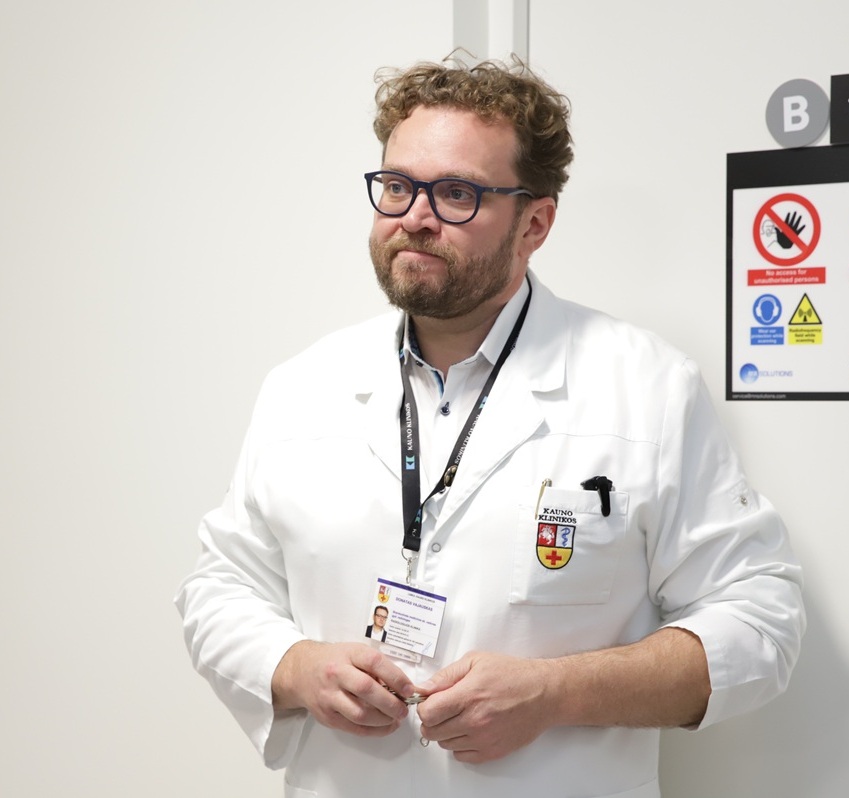
Prof. Donatas Vajauskas, Head of the Nuclear Medicine Research Centre, emphasised: the cyclotron infrastructure provides an opportunity to enter a whole new level of scientific research – from fundamental experiments, in which new radiopharmaceutical compounds are created and tested in the laboratory, to research with animal models and, ultimately, to clinical solutions that will have a real impact on patients.
“The Nuclear Medicine Research Centre is becoming a platform that not only allows for the creation of modern radiopharmaceutical preparations, but also for the development of a long-term competence base in Lithuania. We are implementing this mission through the principles of translational medicine – from the laboratory table to the patient’s bed. We have a lot to be proud of currently, two doctoral students are studying at LSMU, conducting research in the field of radiochemistry, and they are the first doctoral students in this field in Lithuania,” said the head of the centre.
According to doctoral student Agnė Lisauskaitė, working in this infrastructure, she sees every day how theoretical knowledge is transformed into real experiments, and solutions born in the laboratory can become technologies that will help patients in the future.
“Every synthesis experiment I do, every method I improve, and every research result I analyse becomes not only part of my personal scientific maturity, but also a contribution to the wider Lithuanian radiochemistry and nuclear medicine community. Therefore, for me, doctoral studies are an opportunity to make a real contribution to the development of new radiopharmaceuticals, strengthen the country’s scientific potential, and show that we can conduct top-level research in Lithuania that opens up clinical prospects,” said the doctoral student.
Doctoral student Eglė Balčiūnaitytė adds: the cyclotron infrastructure and radiochemistry laboratory is a place where every day we learn not only to apply complex technologies, but also to develop new ideas that could contribute to future diagnostic methods.
“Every experiment is a small step toward a future where diagnostics will be faster and more accurate. I am fascinated by the idea that this process combines not only scientific knowledge but also people’s hopes. It gives us a purpose and meaning—the feeling that our efforts will help people and perhaps even save lives,” emphasised the young researcher.
Cooperation with international experts is already yielding tangible results: from PiB production to new PET tracers and planned clinical trials. According to Prof. A. D. Windhorst, the future of radiochemistry is very exciting. Investment in this field is growing, and the first generation of specialists in Lithuania will lay the foundation for a new era in nuclear medicine.