
European Society of Cardiology Recognition for the LSMU Heart Centre: One of Nine Prestigious Fellowship Recipients Chooses LSMU
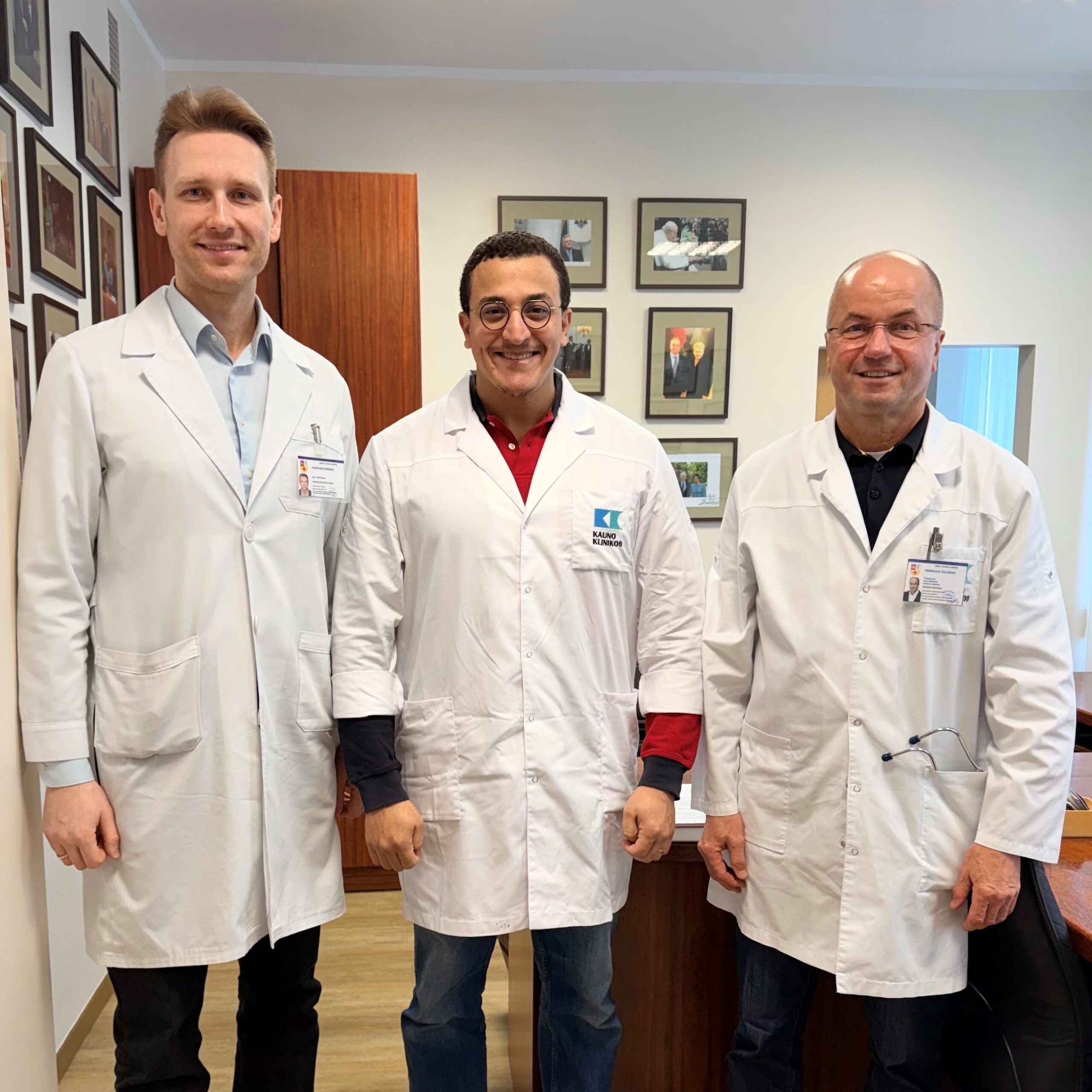
The LSMU Heart Centre, which only began operations in 2026, has already received significant international recognition. One of nine recipients of a prestigious fellowship awarded by the European Society of Cardiology – an organisation uniting more than 100,000 specialists worldwide – selected the Centre for a one-year fellowship in structural heart interventions.
In 2025, the European Society of Cardiology (ESC) fellowship was awarded to only nine physicians across Europe, making it one of the most competitive and internationally recognised professional development programmes in interventional cardiology. The programme focuses on structural heart disease interventions – one of the most complex and rapidly evolving subspecialties in modern cardiology, requiring long-term dedicated training, extensive clinical experience, and multidisciplinary teamwork.
The selection of the LSMU Heart Centre as a host institution became possible only after a rigorous international evaluation process. An application for host institution status was submitted to the committee of the European Association of Percutaneous Cardiovascular Interventions (EAPCI), which, following an independent expert assessment, accredited the LSMU Heart Centre as an official Hosting Centre within the programme framework. According to Assoc. Prof. Dr Kasparas Briedis, Head of the Structural Heart Disease Interventions Sector at the LSMU Heart Centre, who had submitted the application, this accreditation testifies to the institution’s compliance with the highest European standards in structural heart interventions, training environment, teamwork, and clinical practice.
“Structural heart interventions are currently among the most competitive fields in cardiology, both clinically and academically. Candidates prioritise the centres that offer not only a high procedural volume but also a mature team, a clear strategic direction, and a strong academic environment,” says Assoc. Prof. Dr Kasparas Briedis.
He notes that the recognition also carries personal significance: “In 2018, I also was an ESC fellowship recipient. The programme became not only a platform for professional growth but also a gateway into the international professional community. Therefore, the opportunity to host a fellowship recipient at the LSMU Heart Centre today represents a natural continuation and, in a way, a responsibility to pass on what was once given to me.”
Dr Zakaria Naji Lamrani completed his medical studies and cardiology residency in Morocco and spent the past two years undertaking advanced training in Belgium, further developing his expertise in interventional cardiology. Having established a solid foundation in the field, he decided to specialise further in structural heart disease interventions, aiming to achieve the highest level of competence in valve procedures and other complex catheter-based procedures.
This field is characterised by exceptionally strong global competition. In many advanced healthcare systems, including the United States and the United Kingdom, entry into structural intervention fellowships is typically possible only after completing extended subspecialisation in interventional cardiology. For this reason, acceptance into the European Society of Cardiology fellowship programme is considered to be a significant professional achievement.
In Morocco, a country with a population of nearly 40 million, only a small number of specialists currently perform transcatheter aortic valve implantation (TAVI) procedures. Following his fellowship at the LSMU Heart Centre, Dr Zakaria Lamrani intends to return to his home country to contribute to the development of these interventions and to strengthen clinical teams.
The professional connection was established following an international conference where Dr Lamrani became interested in the clinical and research initiatives in structural heart interventions presented by Assoc. Prof. Dr Kasparas Briedis. This was followed by a series of discussions assessing mutual expectations, the strategic direction of the Centre, team expertise, and the fellowship opportunities available.
“It was important for me to find a centre where structural heart interventions are developed not only clinically but also academically. I knew that Assoc. Prof. Dr Kasparas Briedis had also been an ESC fellowship recipient and had personal experience of the programme. This gave me additional confidence that the fellowship would be organised with a clear understanding of both the professional and personal challenges faced by young specialists,” says Dr Zakaria Lamrani. “At the LSMU Heart Centre, there is a clear vision, a strong team, and strong growth potential. I am grateful to the centre for the opportunity to become part of this environment, and I believe the experience gained will help me contribute to the development of structural heart interventions and improvements in patient care upon my return to Morocco.”
Prof. Habil. Dr Remigijus Žaliūnas, Head of the LSMU Heart Centre, emphasises that the Heart Centre model represents a long-term vision shaped in response to changes in modern cardiology. “In recent years, interventional cardiology and cardiac surgery have become increasingly integrated in clinical practice, particularly with the expansion of structural heart disease interventions. Therefore, to ensure the highest quality of patient care, an integrated operational model is required – one that brings together the expertise of cardiologists and cardiothoracic surgeons within a single structure,” states Prof. Žaliūnas.
According to him, such organisational principles are already applied in the most advanced European heart centres. “A modern Heart Centre is not merely an administrative merger but a coordinated clinical system that enables optimisation of processes, more efficient use of resources, and timely multidisciplinary patient care. It is also a prerequisite for international competitiveness and academic visibility.”
Prof. Žaliūnas notes that the fact that one of nine European Society of Cardiology fellowship recipients chose the LSMU Heart Centre sends an important international signal. “It demonstrates that the direction we have chosen is the right one and that the centre’s competencies and potential are recognised not only nationally but also at the European level.”
Assoc. Prof. Dr Briedis adds that international programmes of this kind build not only individual careers but also long-term institutional value. “The development of structural heart interventions today is impossible without international collaboration, exchange of experience, and openness to new ideas. The opportunity to host a European Society of Cardiology fellowship recipient at the LSMU Heart Centre shows that we are ready to be part of this international community.”
According to Assoc. Prof. Dr Briedis, this is only the beginning. “We have a clear strategic direction: to expand expertise in structural heart interventions, strengthen research activities, and nurture a new generation of specialists who think globally. The more international partnerships and joint projects we develop, the stronger our Centre becomes and the broader the opportunities for patients across the region to receive the most advanced treatment.”