
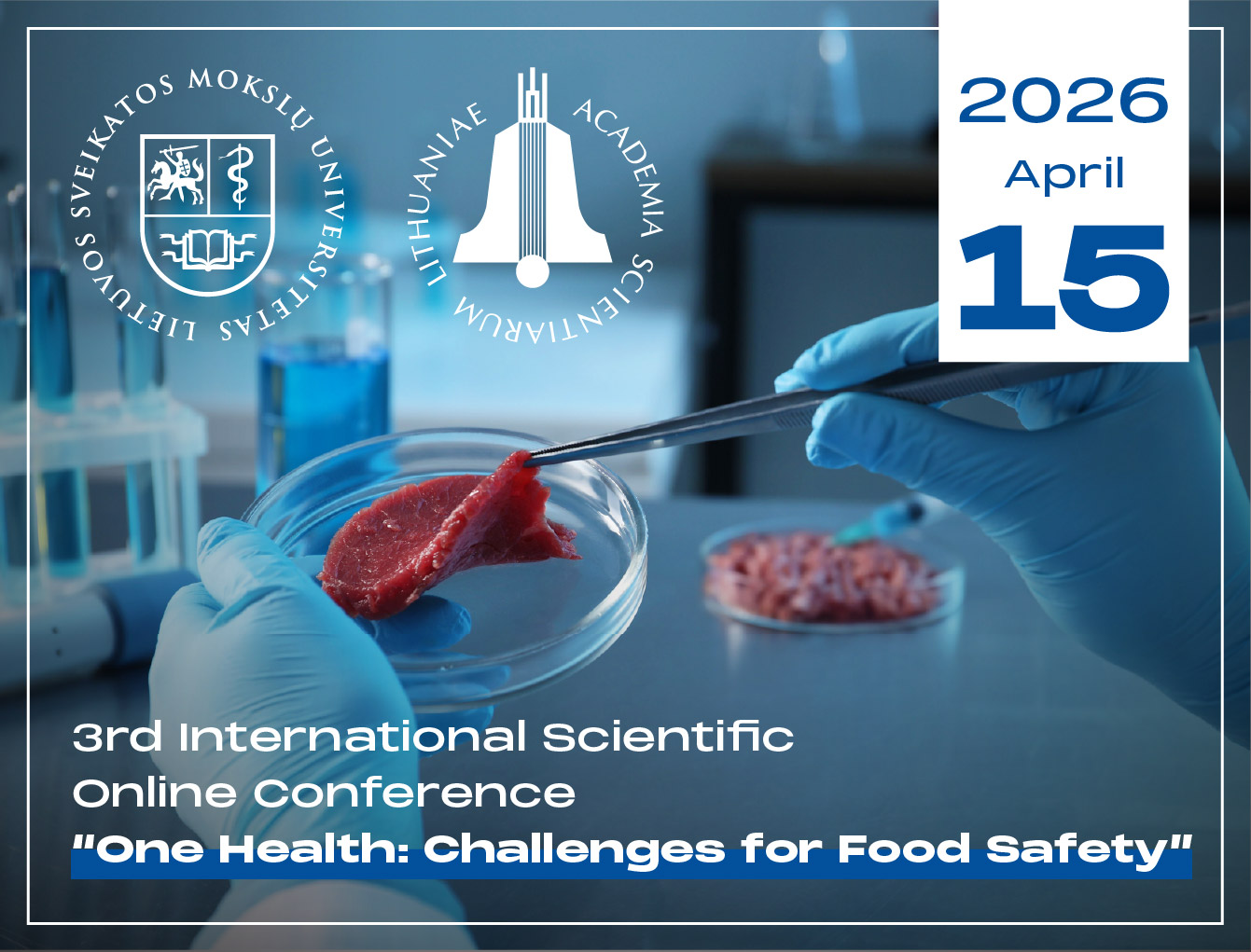
We are pleased to announce and cordially invite you to participate at the 3rd International scientific online conference “One Health: Challenges for Food Safety”, which is organized by Lithuanian University of Health Sciences, Veterinary academy, Department of Food Safety and Quality and Lithuanian Academy of Sciences and will take place virtually through Teams Platform on 15 April 2026, 10 am UTC+02:00.
This year, the conference will focus on the meat production chain, with particular emphasis on it implications for food safety, public health, and sustainable food system development. The thematic areas outlined below will be examined as interconnected components of a comprehensive food safety framework, reflecting their collective importance in ensuring consumer protection and fostering innovation across the sector.
FOCUS TOPICS
- Primary Meat Production
- Safety in the Meat Production Chain
- Quality of the Meat Production Chain
- Technology in the Meat Production Chain
Language: the event will be held in English.
PRESENTATIONS
Oral (15 min) and poster presentations (5 min) are welcome. Please submit your abstract for the presentation at food.safety@lsmu.lt.
- More information about the abstract requirements can be found HERE.
- The poster presentation template can be found HERE.
The abstracts of the conference will be published as a supplement of international scientific open access journal Veterinarija ir Zootechnika (ISSN 1392-2130 (Print), ISSN 2669-2511 (Online)).
ORGANIZING COMMITTEE
- Chairman of the organizing committee: Prof. Dr. Mindaugas Malakauskas, Department of Food Safety and Quality, Lithuanian University of Health Sciences, Lithuania
- Prof. Dr. Loreta Šernienė, Department of Food Safety and Quality, Lithuanian University of Health Sciences, Lithuania
- Prof. Dr. Gintarė Zaborskienė, Department of Food Safety and Quality, Lithuanian University of Health Sciences, Lithuania
- Assoc. Prof. Dr. Aistė Kabašinskienė, Department of Food Safety and Quality, Lithuanian University of Health Sciences, Lithuania
- Assoc. Prof. Dr. Aleksandr Novoslavskij, Department of Food Safety and Quality, Lithuanian University of Health Sciences, Lithuania
- Assoc. Prof. Dr. Kristina Kondrotienė, Department of Food Safety and Quality, Lithuanian University of Health Sciences, Lithuania
- Elvidas Aleksandrovas, Department of Food Safety and Quality, Lithuanian University of Health Sciences, Lithuania
- Agnė Vasiliauskaitė, Department of Food Safety and Quality, Lithuanian University of Health Sciences, Lithuania
SCIENTIFIC COMMITTEE
- Prof. Dr. Gintarė Zaborskienė, Department of Food Safety and Quality, Lithuanian University of Health Sciences, Lithuania
- Prof. Dr. Dusan Misic, Department of Functional Food Products Development, Faculty of Biotechnology and Food Science, Wroclaw University of Environmental and Life Sciences, Poland
- Assoc. Prof. Dr. Aistė Kabašinskienė, Department of Food Safety and Quality, Lithuanian University of Health Sciences, Lithuania
- Assoc. Prof. Dr. Aleksandr Novoslavskij, Department of Food Safety and Quality, Lithuanian University of Health Sciences, Lithuania
- Assoc. Prof. Dr. Kristina Kondrotienė, Department of Food Safety and Quality, Lithuanian University of Health Sciences, Lithuania
- Assoc. Prof. Dr. Joanna Wojtacka. Department of Veterinary Public Health, Faculty of Veterinary Medicine, University of Warmia and Mazury in Olsztyn, Poland