
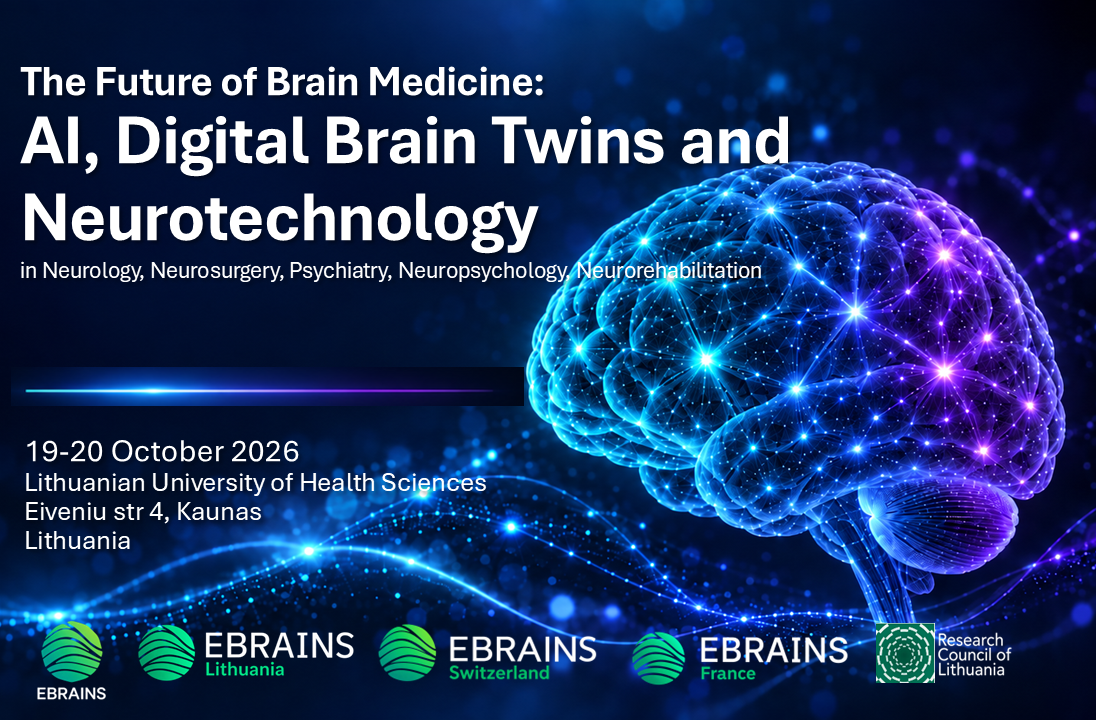
We warmly invite clinicians, psychologists, artificial intelligence experts, researchers, PhD students, postdoctoral fellows, medical residents, biomedical engineers, data scientists, neurotechnology developers, experts in bioethics and medical ethics, healthcare professionals, and students interested in the applications of artificial intelligence, neurotechnology, digital brain twins, brain–heart interactions, responsible AI, and personalised medicine in neurology, neurosurgery, psychiatry, neuropsychology, and neurorehabilitation to meet at the EBRAINS Symposium on Neuroscience and Artificial Intelligence.
The event is organised by the EBRAINS Lithuania (LSMU, VDU, KTU and LSMU Hospital Kauno klinikos), EBRAINS Switzerland, EBRAINS France, Lithuanian Society of Neurologists, Research Council of Lithuania.
The General Chair of the event is Prof. Viktor Jirsa, Chief Science Officer of EBRAINS, Aix-Marseille University, France.
The symposium will explore how artificial intelligence, digital brain twins, neuromodulation, wearable technologies, and smart technologies can contribute to the development of precision and personalised medicine in neurology, neurosurgery, psychiatry, neuropsychology, and neurorehabilitation. Particular attention will be given to AI-based assessment of clinical data, personalised digital models of the patient’s brain, the use of smartphones and wearable sensors for health monitoring, research on brain–heart interactions, and emerging approaches to neuromodulation. The symposium will also address the challenges of implementing these technologies in healthcare, including issues related to responsible AI, bioethics, medical ethics, and their impact on patients and society.
19 October 2026 – EBRAINS School and Hands-on Workshops:
EBRAINS, The Virtual Brain, and Artificial Intelligence. The programme will include presentations by early-career researchers and practical sessions introducing AI foundation models based on deep neural networks, as well as the EBRAINS “The Virtual Brain” methodology, which enables the development of personalised digital models of patients’ brains for applications in diagnosis, assessment of disease progression, and treatment planning.
20 October 2026 – EBRAINS Symposium:
Artificial Intelligence, Virtual Brain Twins, and Precision Medicine. Invited experts from the EBRAINS Switzerland and EBRAINS France National Nodes, as well as leading European clinical and research institutions, will present the latest advances in clinical neuroscience, artificial intelligence, and neurotechnology.
The scientific programme will conclude with the panel discussion “The Virtual Clinic: Promise, Risk, and Ethics in AI-Driven Medicine’ bringing together experts in neuroscience, neurology, neurosurgery, artificial intelligence, digital health, and biomedical engineering to discuss how AI and virtual patient technologies may transform future clinical practice.
We invite early-career researchers to present their work!
Abstracts from Master’s students, PhD students, postdoctoral researchers, and medical residents will be accepted until 10 October 2026. Please send a one-page abstract in MS Word format by email to ebrains@lsmu.lt Authors of selected abstracts will be invited to give 15-minute oral presentations on 19 October 2026.
Information: ebrains@lsmu.lt
Registration and program: https://reg.eventas.lt/website/20856/
Looking forward to welcoming you at the Symposium!
Programme Committee:
Dr. Damien Depannemaecker (Aix-Marseille Université, EBRAINS France)
Dr. Birgit Schaffhauser (Lausanne University Hospital (CHUV), EBRAINS Switzerland)
Prof. Ausra Saudargiene (Lithuanian University of Health Sciences, EBRAINS Lithuania)
Local Organisers:
Prof. Ausra Saudargiene (Lithuanian University of Health Sciences; Vytautas Magnus University, EBRAINS Lithuania)
Prof. Kęstutis Petrikonis (Lithuanian University of Health Sciences; Lithuanian Society of Neurologists; EBRAINS Lithuania)
Prof. Tomas Lapinskas (Hospital of Lithuanian University of Health Sciences Kauno klinikos; EBRAINS Lithuania)
Prof. Vaidotas Marozas (Kaunas University of Technology; EBRAINS Lithuania)
Prof. Saulius Šatkauskas (Vytautas Magnus University; EBRAINS Lithuania)
PhD Vytautas Kučinskas (Lithuanian University of Health Sciences; EBRAINS Lithuania)