Physiotherapist: Human Movement is like a Fingerprint, and Lived Experience is the Best Way to Learn
Human movement seems such a natural function of the body that we take it for granted in everyday life. The latest research in movement science reveals what is still little known to the wider public: intriguing links between movement and learning.
It is becoming clear that we learn most effectively not through monotonous repetition, but through lived experience, adapting and exploring. These insights are already transforming not only rehabilitation and sports practices but also offering a broader perspective on the human capacity to adapt to a constantly changing world.
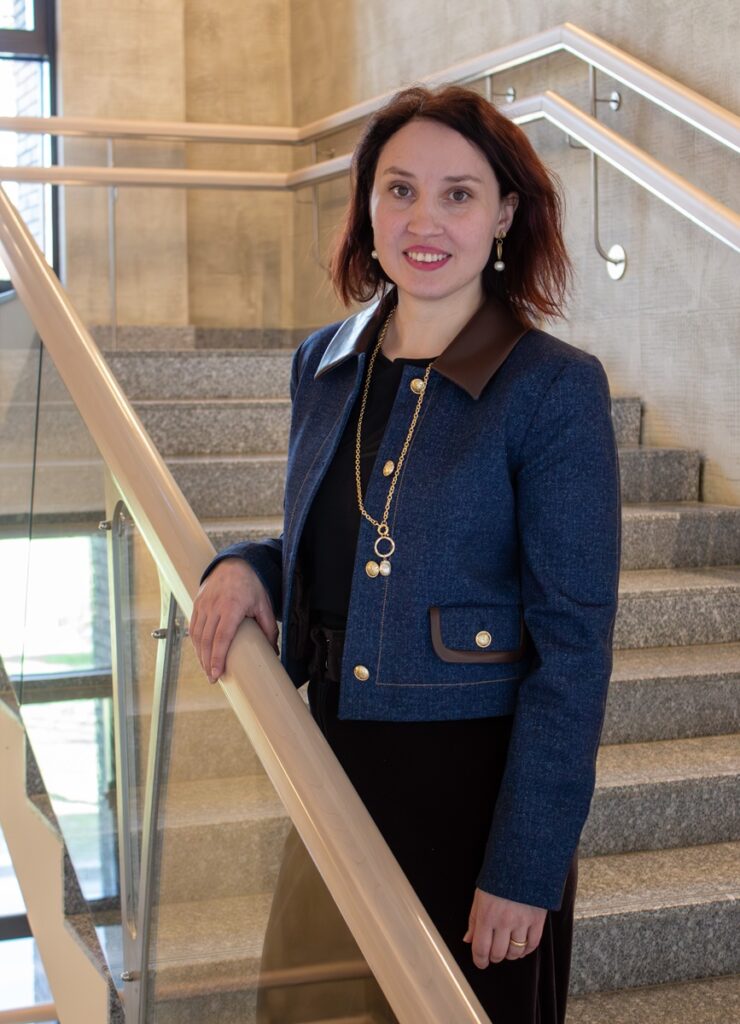
We have discussed this in a conversation with Agnė Slapšinskaitė-Dackevičienė, physiotherapist, Associate Professor at the Department of Sports Medicine of the Faculty of Nursing, and Senior Researcher at the Health Research Institute at the Lithuanian University of Health Sciences (LSMU).
According to the researcher, our movements are not mechanical repetitions of identical actions – they form a dynamic, ever-changing system reflecting our physiology and emotional state. Each person’s movement is unique: even the smallest micro-movement can serve as a biometric identifier – like a fingerprint.
What new discoveries have been made about movement, and why are they significant?
Movement is an integral part of everyday life – from simple morning routines to complex artistic or professional activities. For example, you can pick up a cup of coffee in a thousand different ways, because our central nervous system allows for a wide range of movement variation.
Modern science increasingly shows that movement is not an identically repeatable process. Based on Nikolai Bernstein’s concept of “repetition without repetition”, each execution of a movement contains variability.
Even if the same person performs the same action repeatedly, it will differ slightly each time depending on the state of the nervous system, fatigue, emotions, or circadian rhythms. For this reason, movement becomes individual – like a signature or fingerprint.
This individuality has practical significance: in everyday life, we often recognise people by the way they move and their specific movements. Movement analysis is already widely used in biometrics and forensic science – for example, in some countries individuals can be identified by their gait alone.
The ability to vary movement is directly linked to safety and injury prevention. Movement variability is a valuable trait that helps us adapt to the world. For example, children growing up in Lithuania learn to walk on ice: their central nervous system and muscles learn from the environment and interact with it. If you are visiting Lithuania and encountering ice for the first time, your central nervous system is much less adapted to this kind of environment, and you fall more often.
If you do not train variability, do not attempt to perform a movement in a different way than we are used to, we reduce our movement repertoire and adaptability, increasing the risk of injury, especially in older age.
Variability is a broadly applicable concept both in rehabilitation and in a gym.
Movement and learning: how are they connected?
Movement is a learned ability closely linked to general learning processes. However, traditional repetition-based approaches are increasingly questioned.
Repetitive learning – repetitive performance of an identical action – is considered less effective, particularly in older individuals. Learning by repetition should be exercised among children below 12. Starting the age of 13, a movement should be performed identically no more than three times to make sure that it still holds the subjective information, which is new to the learner.
Scientific evidence shows that excessive repetition reduces new information and slows learning.
An alternative is contextual interference and differential learning, based on variation of environment, tasks, movement execution modes. Differential learning introduced by Professor Wolfgang Schöllhorn prompts the system to self-organise by maintaining a high level of “subjective information”, i.e. by keeping a component of novelty for the learner.
Learning movement is not linear: even relearning a skill leads to a different execution due to changes in the body and experience. For example, if you return to a gym or physiotherapy sessions after a longer pause, you may have forgotten a certain movement and will be learning to execute it in a completely different way than previously. As Heraclitus said, you cannot step into the same river twice.
The differential approach to learning movement was borrowed by the field of rehabilitation from sports back in 2009. It may sometimes take decades for scientific knowledge to find way into daily practice – this method is still too little known in Lithuania and even Europe.
Interestingly, differential learning used to be applied in other areas of learning, such as learning to write at schools in Germany. Instead of a single “right” model, children would be provided with different conditions to experiment using different writing surfaces, tools, and body positions. The aim was to enable the child to discover the most appropriate individual movement pattern for their central nervous system and muscular system having tried out and accumulated diverse writing experience.
This approach relies on the systems theory, neurophysiology, and reform pedagogy (underpinned by the ideas proposed by Jean-Jacques Rousseau, Friedrich Fröbel, and Maria Montessori), emphasising the individual experience and enriching learning environment.
Where is global science heading in this field, and what is in the focus?
Contemporary movement science is developing in two directions: the integration of technology and the analysis of subjective information. In this respect, we are living through a genuine revolution.
Advanced technologies – 3D motion capture systems, wearable sensors, and artificial intelligence – make it possible to analyse not only movement parameters, but also more complex indicators, such as fluctuations. These can function as biomarkers, helping to diagnose or monitor conditions such as Parkinson’s disease.
What happens, for instance, when analysing the same gait? We can observe not only stride length, speed, and amplitude, and evaluate the effectiveness of treatment, but also monitor so-called fluctuations – oscillations within the biomechanical signal. If a person has Parkinson’s disease, these oscillations will differ from those of healthy individuals. Professor Jeffrey Hausdorff of Tel Aviv University, who researches this phenomenon, argues that fluctuations are not merely background noise, but a biomarker that helps identify the earliest signs of the freezing of gait (FoG) characteristic of Parkinson’s disease.
When observing the effectiveness of different learning methods, electroencephalography studies reveal how brain activity changes – how the brain is activated or inhibited during movement, and what occurs following training conducted using differential learning.
Another important direction is the assessment of subjective experience. Growing attention is being paid to how a person perceives their own body, how they interpret movement, how they are able to sense what is happening within the body, recognise new information, and use it to adapt. This capacity is considered essential both for learning and for high-level performance in sport.
The objective task may be identical for everyone – for example, walking across a balance beam – yet the subjective experience will differ fundamentally: for a professional athlete, it will be an almost automatic action; for a less experienced person, a demanding task; and for someone with a fear of heights, perhaps even a traumatic experience.
It is therefore important for a therapist, coach, or teacher not only to measure movement, but also to understand how the individual experiences it. Appropriately chosen small challenges can help reveal which learning method is best suited to a particular person.
In summary, movement and learning are inseparable processes, dependent on initial conditions and continuous change. Even minor adjustments can significantly affect movement execution, particularly in the early stages of learning. It is therefore crucial to cultivate the ability to vary, adapt, and explore. Learning takes place not through mechanical repetition, but through lived experience – a journey that itself becomes the destination.
A publication of exceptional value for rehabilitation and sports professionals
These insights are brought together in the book Differential Learning in Physiotherapy. The editors are Wolfgang Schöllhorn and Agnė Slapšinskaitė-Dackevičienė. Other LSMU researchers who contributed to the book are Dr Deivydas Velička and Vidmantas Zaveckas.
At the public launch of Differential Learning in Physiotherapy on 27th April, one of the editors, Professor Wolfgang Schöllhorn, offered detailed examples to illustrate what readers can expect.
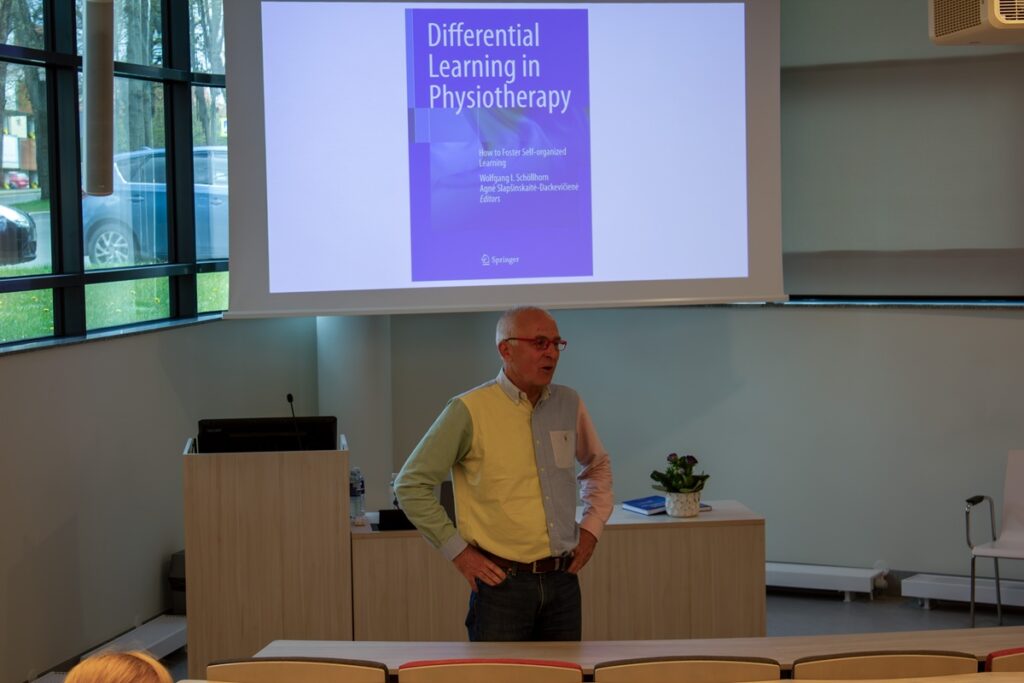
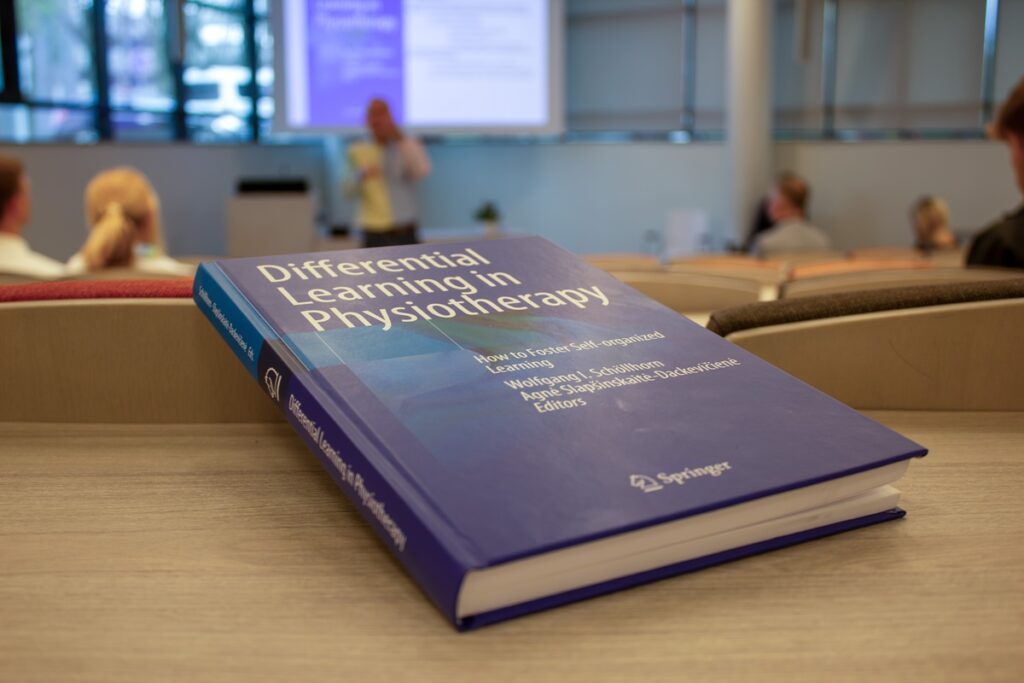
“Most of the methods used in physiotherapy today were initially tested in sport. In other words, the methods currently in use are the result of a long process of work with professional athletes. That is precisely why we did not focus solely on one area, but expanded our knowledge and its application more widely,” said one of the editors, speaking about how the book came to be written.
Those who were interested in the book had the opportunity not only to be among the first to browse through it, but also to put their questions directly to Professor Schöllhorn and the co-authors representing LSMU.
Back