Quality assurance

< Back

PRINCIPLES OF QUALITY MANAGEMENT

The quality of the University’s performance is based on a coherent and continuous process, covering all areas of the institution’s activities and ensuring continuous improvement of the operational processes. It is based on the principle of continuous improvement and shared responsibility practised by all members of the community.

The pursuit of quality is not just a formal requirement, but a daily practice that shapes a quality culture that is supported by dialogue, openness and cooperation between university staff, students, external partners and other stakeholders.

Quality management helps to ensure public confidence in the University. To achieve this, the University applies integrated and reasonable methods, tools and practices that form the University’s quality management system. This system allows the University to adapt flexibly to changing conditions, to ensure continuous improvement and to generate added value for both the academic community and society.

LEADERSHIP AND QUALITY MANAGEMENT COMMITMENTS

Responsibility for quality management is consistent with the duties and rights of members of the community as defined in the University’s Statute and other legislation and is integrated into daily activities. The Rector of the University is responsible for leadership and the overall quality of the University’s activities and results, sharing responsibility with Vice-Rectors according to their areas of activity. The Quality and Strategy Monitoring Service, together with the Quality Commission, coordinates the quality management of the University. The deans of faculties and directors of research institutes, as well as the heads of the University’s administrative departments, are responsible for the quality of their departments’ activities and results. Each member of the community is responsible for the quality of their work and activities and their improvement in their role as:

  • researcher;
  • lecturer;
  • student;
  • administrative staff.

The University’s quality management system is based on the   provisions of the European Standard for Higher Education ESG2015 and is implemented through a continuous improvement cycle model.

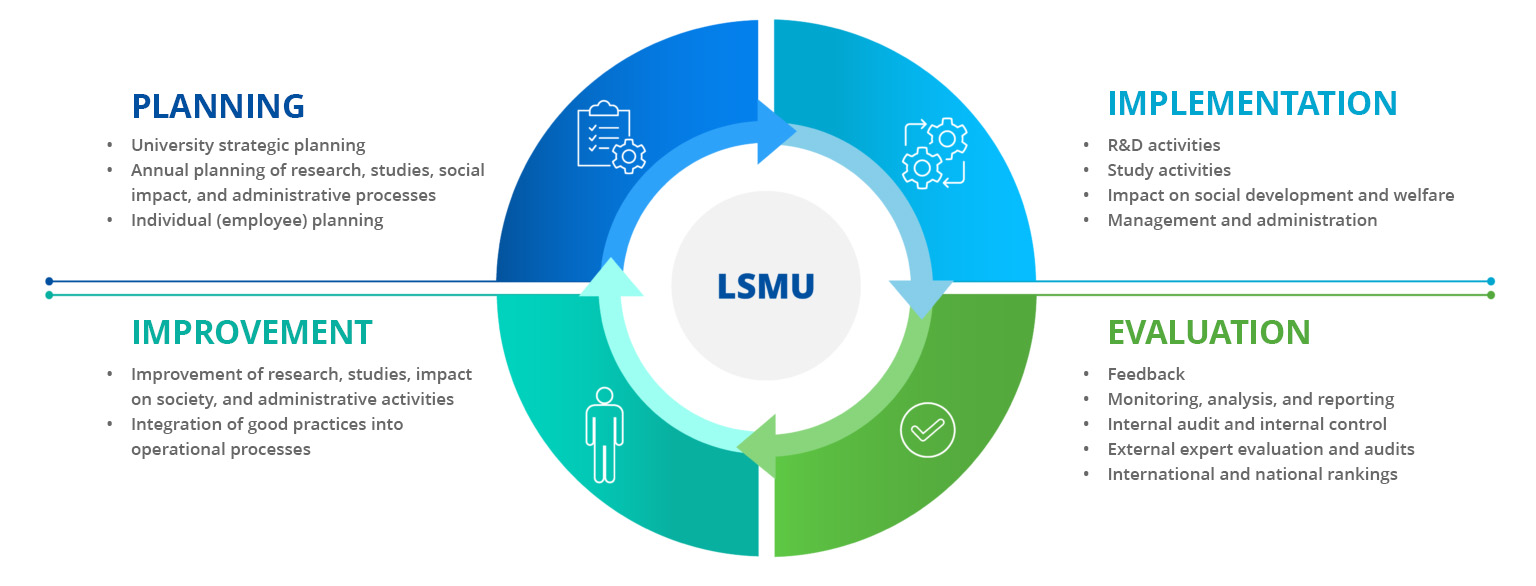
The quality assurance system of the University is based on the model of the continuous improvement cycle ( PDCA: Plan, do, Check, Act / Adjust), which is designed for the systematic management of operational processes, decision-making and improvement of performance. This quality assurance model helps create a quality culture at the university, encouraging consistent improvement of performance efficiency and quality.

LSMU Quality
Planning

The quality assurance of the University’s activities begins with purposeful planning in the fields of research, studies, impact on society and management. University Statute the mission, goals, objectives and vision are used as the basis for strategic planning, strategic development guidelines and other operational planning documents. In the light of these, the University’s departments shall draw up annual action plans, which shall serve as a basis for individual action plans (if applicable) for the staff of the University’s departments. The interlinking of planning activities ensures the coherence of strategic, annual and individual action plans, the integrity of processes, and the rational allocation and efficient use of available financial, human and material resources. Planning processes at the University Regulated by legislation.

The University’s vision is defined in the University’s Strategic Development Guidelines for 2022–2026 as – Europe’s leading health sciences university for societal prosperity, and is implemented by the entire University community. The implementation of the University’s vision and mission, as well as its strategic action plan, is based on the core values of the community: respect for life, community, academicity, openness, professionalism and justice.

The long-term Strategic Management Planning Documents strategy also includes faculties and research institutes and targeted university strategies.

The purpose of annual planning is to detail the implementation of the tasks and measures provided for in the strategic level planning documents by preparing annual activity plans, continuous activities, procedures, rules and other. The annual activity plan of the department shall include specific activities, measures to achieve the objectives, expected results, responsible persons and deadlines for the implementation of planned activities. Annual planning of activities in the fields of studies and research is carried out systematically at the University, through the planning and implementation of annual study plans, curriculum renewal measures, the improvement of teaching content and methods, research and publication plans, as well as the improvement of the qualification of lecturers and researchers.

The University employee shall draw up an individual action plan in accordance with the department’s annual activity plan. Action Plan (if applicable). An individual performance plan helps to clarify the employee’s responsibilities, objectives and expected results and allows for an objective evaluation of performance at the end of the year. The planning process promotes a culture of responsibility at the university, continuity of activities and continuous improvement.

Implementation

At this stage, the tasks that have been set during the planning process are fulfilled, which are implemented in the planned terms and resources, data is collected and results are recorded for further evaluation.

The University’s research and innovation activities are based on the principles of transparency, accountability, openness and efficient resource management. These principles ensure consistent scientific development, quality continuity and compliance with international standards. Researchers work with the business sector, social partners and students to carry out cutting-edge research, develop innovations and translate them into practical applications that create economic and social value. It promotes the development of scientific and general competences, creativity, innovative thinking and entrepreneurial skills. This creates an environment where ideas are turned into solutions and knowledge into new opportunities.

The conduct of scientific activities at the University is governed by LSMU Regulation on Scientific Activities.

The quality assurance system of studies at the University is based on the quality assurance provisions of studies at the European Higher Education Area (ESG 2015) defined in the internal documents of the University: Study Quality Guide and Regulation of Studies. The entire University community and social partners are involved in the quality assurance process. This process includes: the management of the study process (including, but not limited to, faculty-based study programme committees, which ensure the quality implementation of study programmes), the principle of student-centred teaching, an effective system for the development of faculty members’ competences, and the continuous monitoring and evaluation of the study process. More detailed study quality assurance processes and activities are described here.

The University purposefully implements initiatives that contribute to the development of society and the strengthening of well-being. The initiatives planned at this stage, which are based on the University’s values, move to the practical level of activity – creating solutions and initiatives that promote sustainable development, social cohesion and innovation. Lecturers, researchers and students are involved in social and civic initiatives, volunteering programmes and applied projects that allow them to make a practical contribution to the well-being of society. The result of this phase is real change, resulting from the University’s knowledge, creativity and collaboration, which contributes to society’s growth, prosperity and a sustainable future. Activities shall be implemented in accordance with the strategic planning and quality management documents LSMU Quality Assurance Policy, LSMU Strategic Development Guidelines.

The implementation of the University’s management and administrative processes is based on the principles of efficiency, transparency and accountability. The University’s administrative structures act as a link between the academic community, students and external partners to ensure coherent coordination of processes and the appropriate use of resources. Implementation of management solutions strengthens institutional efficiency of management, improves processes, applies modern management practices and digital tools.

Open communication, employee competence building and community involvement in decision-making processes are ensured. These activities are implemented in accordance with strategic planning and quality management documents LSMU Quality Assurance Policy, LSMU Strategic Development Guidelines, LSMU Good Management Code, Equal Opportunity Policy, as well as Prevention of Corruption measures.

Assessment

The implementation of the University’s performance assessment is based on clearly defined principles, processes and methodologies that meet national and international quality standards. In the process of performance evaluation, quantitative and qualitative data are analysed, valuable feedback is shared between community members, social partners and other stakeholders. National and international experts provide recommendations during institutional, course and research evaluations. The quality of the University’s studies and the results of its research activities are compared in national and international rankings of higher education institutions. Those responsible for analysing data on internal quality processes systematically collect and analyse the data, make it publicly available to the community, and provide it to the University’s management for evaluation, identifying successes and areas for improvement that promote progress.

In order to raise the calibre of the university’s operations, input is gathered from the community, social partners, and other interested parties. The University organises feedback in accordance with the Description of the procedure for the organisation of feedback on the activities of the University. The Quality Commission is in charge of overseeing the University’s execution of feedback; it authorises the creation of feedback forms for LSMU activities, evaluates the results of the submitted feedback , and offers recommendations for raising the calibre of university activities.

The monitoring, evaluation and improvement of the quality of studies at the Lithuanian University of Health Sciences is coordinated by Study Quality Monitoring and Assurance Commission.

This phase systematically assesses the results of implemented activities, the effectiveness of processes and their compliance with strategic objectives and quality standards. Quantitative and qualitative data on study, science, innovation and administration activities are analysed. The assessment includes monitoring performance indicators, risk analysis, assessment of progress and preparation of Periodic reports.

The results of analyses and reports are presented to the University community and social partners, ensuring openness, transparency and accountability. They form the basis for further decisions – helping to identify areas of strength and areas for improvement, to initiate change and to make recommendations for the next phase of planning.

Internal Audit Service examines and evaluates the governance, risk management and internal control systems of the University, the legal entities subordinated and/or accountable to the University, as well as the process of administering the use of the European Union and/or international financial assistance received by the University. Internal control at the University LSMU Internal Control Procedures is implemented in accordance with the establishment of an internal control system. This description defines the essential principles by which the responsible persons of the University can properly create, maintain and execute the objectives of internal control, including proper and timely management of operational risks.

The University’s operational risks are identified and managed in accordance LSMU Risk Management Policy with the Risk Management Framework, which sets out the objectives, principles, actors and functions of risk management. You can learn more about the principles of internal control and risk management here.

Independent experts and external bodies systematically analyse the University’s operational, management, study, research and innovation processes, assessing their compliance with national and international quality standards. The experts’ findings, recommendations and audit results provide valuable feedback to help the university improve the quality of its operations, strengthen accountability and transparency. Study quality assessment Centre (SKVC) carry out the external evaluation of the activities and fields of study of higher education institutions with the help of Lithuanian and international experts. Annual and periodic evaluations of research performance in Lithuania are carried out by the Research Council of Lithuania. The aim of these evaluations is to assess the scientific (artistic) performance of science and higher education institutions, and to make the results of the evaluations publicly available to the institutions that formulate and implement science and higher education policy.

External institutional assessment

An external institutional evaluation of LSMU was carried out in 2023. The activities of LSMU were evaluated and accredited by international experts positively for a maximum period of 7 years. The University’s strong partnership with healthcare institutions, quality infrastructure, active student participation in the governance of the University and attention to social responsibility were highlighted. For more information on the external institutional evaluation, see here.

External evaluation of fields of study

On the basis of the findings of the periodic external evaluation of the fields of study, study programmes at LSMU are accredited. Detailed information on the results of the fields of study evaluation is available here.

External evaluation of research activities

The Research Council of Lithuania carries out the following evaluations of research (art) activities, the aim of which is to assess the research (art) activities of research and study institutions, and to make the results of the evaluations publicly available to the institutions that formulate and implement research and study policy. Ongoing evaluations:

The University systematically uses the results of international and national rankings to objectively assess the quality of its activities, performance and competitiveness. The results of the rankings allow us to identify areas of strength and areas for improvement in the University’s activities. The University participates in the following rankings:

  • QS World University Ranking by Subject – a global ranking in which higher education institutions are ranked according to individual fields of study.
  • THE World University ranking – a global ranking of higher education institutions based on the quality of their research, teaching, internationality, number of citations and generated industrial income.
  • THE Impact Rankings – a global ranking in which higher education institutions are assessed in accordance with the United Nations Sustainable Development goals ( Sustainable Development goals).
  • GreenMetric – a global ranking in which higher education institutions are assessed in accordance with their sustainability practices, environmental policies and contributions to the achievement of the Sustainable Development goals.
  • Reitingai (En. The Rankings) – a national rating magazine, which provides information about Lithuanian educational and scientific institutions
Rankings Position
2020 2021 2022 2023 2024 2025
The World University rankings no data no data 601-800 801-1000 801-1000 1001-1200
501-550 401-450 401-450 401-450 501-550 601-650
no data no data no data 801-1000 801-1000 401-600
no data no data no data no data no data 1205
5 5 3 2 2 2

Improvement

Improvement is an important strand of quality and strategic management that enables the University to continuously raise the level of quality of its activities and ensure the achievement of its strategic objectives. In order to achieve a transparent and reasonable    process of decision-making improvement of  the management of the University, the entire university community is actively involved in it. The  plan-do-check-act (quality assurance cycle) provides systematic feedback to process participants about the changes and improvements that are being implemented (follow-up activities).

The university has created a plan of action to carry out the recommendations made during the external review, taking into consideration the findings and suggestions of international, independent experts given during the institutional evaluation.

Initiatives aimed at improving societal growth and well-being change and advance in response to input and demands from society. The substance and methods of implementation of these efforts are continuously updated and improved by developments in national and international legislation and declarations.

The University improves the processes of research activities based on the findings of the formal (annual) evaluation of research activities conducted by the Research Council of Lithuania and the comparative expert evaluation of research activities carried out every five years by the Research and Higher Education Monitoring and Analysis Centre MOSTA. This includes reviewing the priorities and directions of research and experimental development (R&D), discussing the distribution and attraction of funds of the University and research institutes, and considering new initiatives of international cooperation that promote the quality of publications and the development of scientific competencies.

The results of external expert evaluations of study fields, internal analysis of the quality assessment of study programs conducted by study programme committees, and feedback from university students, lecturers, and social partners are all taken into consideration when improving the university’s study programmes. The content of study programmes, the necessity of updating the study infrastructure, and other measures of programme implementation in the course of high-quality studies at the university are all evaluated based on the information and data gathered.

 The Quality and Strategy Monitoring Department oversees the coordination of the quality assurance system, ensures that its efficacy is continuously improved, and promptly monitors outcomes.

Quality and Strategy Monitoring Department
A. Mickevičiaus str. 9, Kaunas, Lietuva
Visi kontaktai