Becoming a neurosurgeon: beyond the illusion of heroism
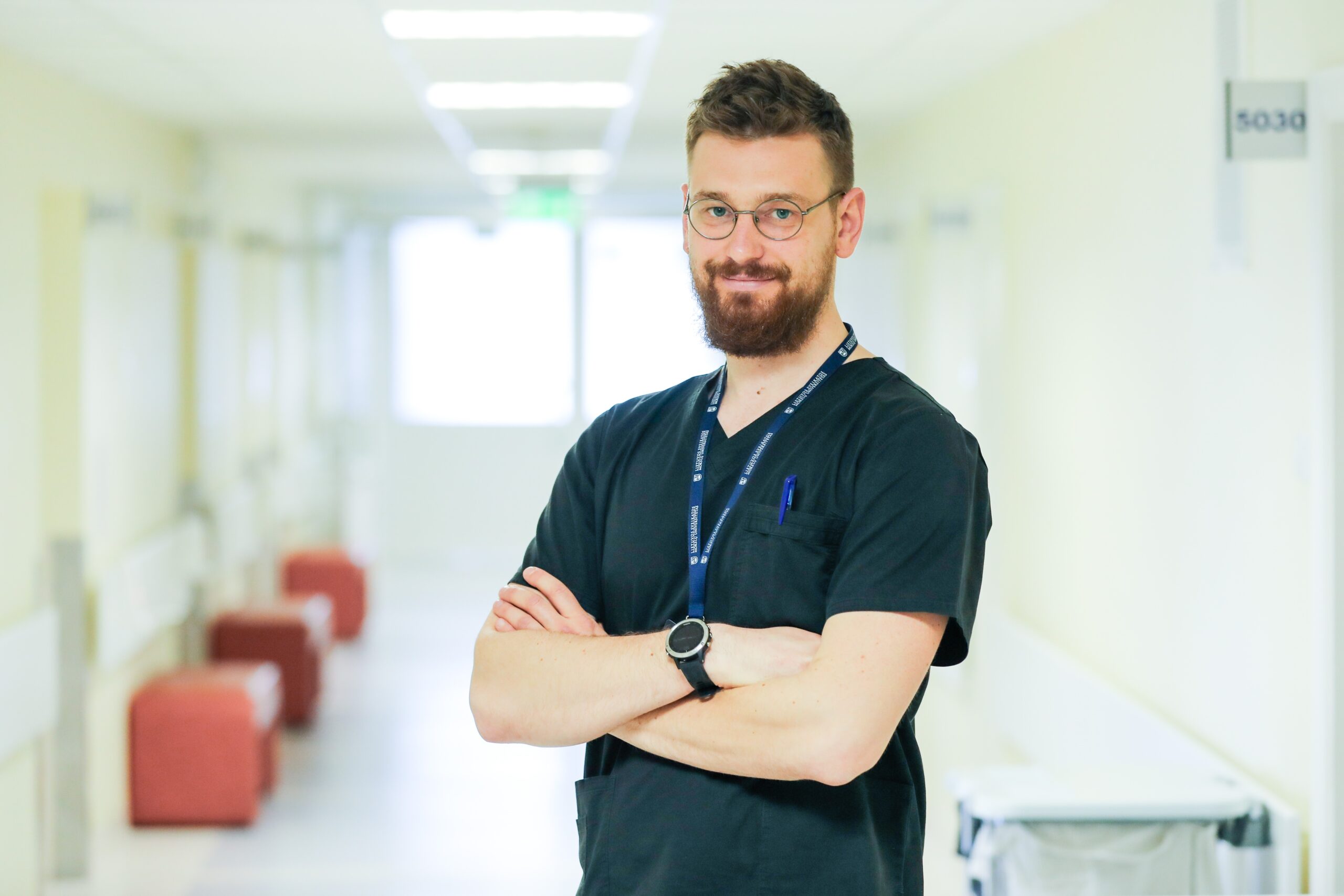
“If you want to be good doctors, go to the hospital, be around people, stay close with patients, interact and cooperate with them,” neurosurgeon Karolis Bareikis often urges medical students.
This advice comes from the doctor’s own professional experience. Having started working at an Emergency Room as early as during his second year of medical studies, the future medical doctor gained practical skills and learned the basics of a doctor’s conduct – not to be afraid of people, not to hesitate to touch or speak to patients, regardless of their social status or the health issue they present with.
“I realised that being a good doctor means being present with the person in your care,” says the doctor.
Today, Karolis Bareikis, a neurosurgeon at the Clinical Department of Neurosurgery of the LSMU Hospital Kauno Klinikos, spends many hours in the operating theatre and makes high-stakes decisions on a daily basis in treating complex, life-critical conditions – from brain and spinal tumours to vascular pathologies.
A doctor’s work, however, is far from confined to the operating theatre. It encompasses the entire treatment process – from examining the patient and analysing diagnostic tests to post-operative care and thorough, individual preparation for each upcoming case.
Each day conventionally begins with the doctors’ pre-shift huddles, which are essentially brief, yet important, 5-minute meetings among the colleagues to discuss patient cases, establish treatment plans, and tackle the most challenging clinical questions. The doctor also dedicates a substantial amount of time to academic activity, sharing his knowledge and experience with future doctors at the Lithuanian University of Health Sciences (LSMU).
Reflecting on his professional journey, he emphasises the aspects that matter most in the medical profession.
Is studying medicine difficult?
“People often ask: is studying medicine difficult? Yes, it is. Why? Because the human body is extremely complex, there is a vast amount of information about it, and that knowledge is constantly evolving,” the doctor notes.
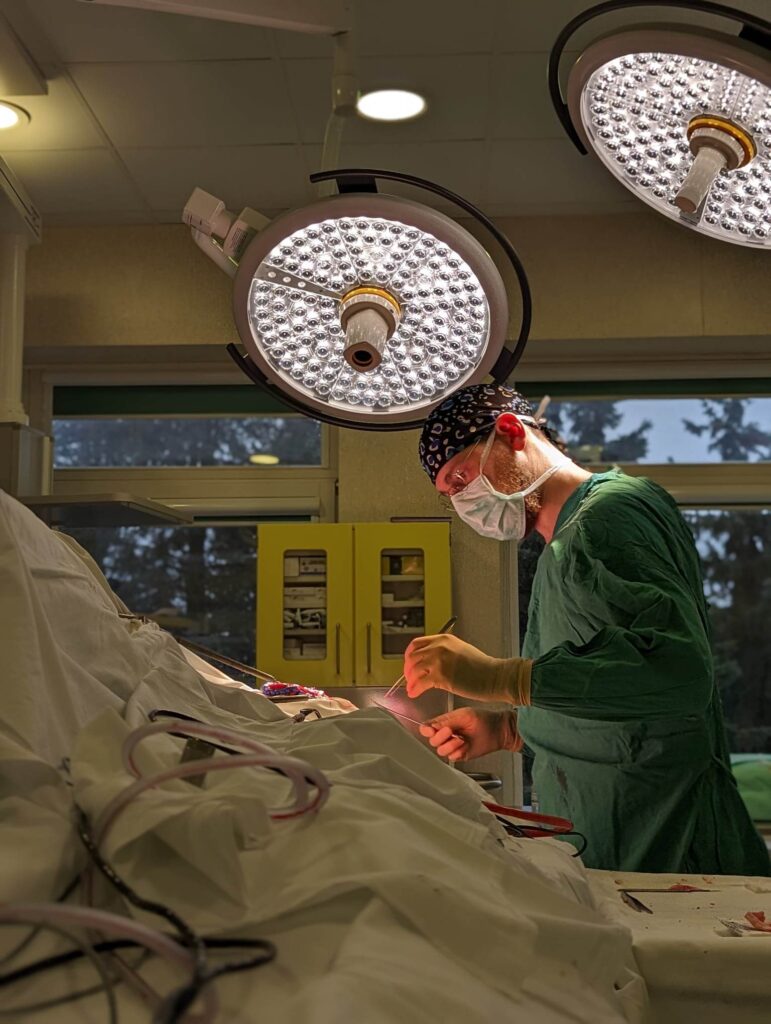
For him, the ambition to study medicine took shape in childhood. Although there were no doctors in his family, he was influenced by strong values, role models, and encouragement from relatives. Later, real-life examples further reinforced his choice – operations performed by renowned doctors such as cardiac surgeon Professor Vytautas Sirvydis and Professor Mečislovas Vitkus, a pioneer of microsurgery in Lithuania:
“I admired them as heroes – and I wanted to become one myself. So, when the time came to choose, the path of a doctor felt natural. It also mattered that I did well in the sciences at school,” he recalls.
According to K. Bareikis, medical studies rest on three key pillars: first, students acquire theoretical knowledge; then they develop practical skills; and finally, they shape their professional conduct – their relationship with patients and with the healthcare institution:
“In the military no one is sent straight into battle. An inexperienced pilot is not entrusted with a complex aircraft. The same applies in medicine: basic skills are first learned safely – using models, mannequins, and advanced medical simulation equipment. Only later, during placements in a university hospital, do students begin to integrate their knowledge and skills into clinical practice: they communicate with patients, observe symptoms, and start to recognise what kind of health issue or diagnosis it might be.”
He is open about the fact that there is little comfort in medicine, and it is not just the beginning that is challenging. At first, due to a lack of experience and confidence, it can be difficult to communicate with patients or to trust one’s own knowledge and decisions. However, by working with people, putting in the effort, studying, and gaining experience, both self-confidence and professional competence grow over time.
A professional is shaped by more than just studies
For K. Bareikis, the first year of medical studies did not seem particularly difficult – however, a real breakthrough came in the second year. Working in the Emergency Room helped him grow as a future professional, enriching both his knowledge and life experience.
Community also played an important role during his studies. The choir he joined at the time became not only a creative space but also a network of like-minded professionals.
“We were all quite hungry for medicine, and the choir was our shared passion. When you are surrounded by people who take medicine seriously, you start to push yourself more. That circle of people has remained.
In modern medicine, it is difficult to achieve much on your own, no matter how skilled you are: in almost every field, work is performed in teams, and if you don’t have one or cannot function within one, treating patients becomes challenging,” the doctor shares.
One of the most vivid moments during his studies was encountering the true scale of surgery:
“I thought that working in the hospital emergency room, I had already seen a lot, but then we had a course in plastic and reconstructive surgery taught by Professor Rytis Rimdeika.
When the professor opened his archive of cases and photographs, I realised that I had virtually no understanding about surgery – I saw how much I still didn’t know, how vast the field is, and how much can be done within it to help people.”
This realisation became an important turning point – the moment when genuine professional growth began.
Specialisation: not a romantic endeavour, but the path towards your choice
K. Bareikis did not discover neurosurgery as his future specialisation straight away. The decision matured gradually, by ruling out other fields. Before making his final decision, he tried his hand at obstetrics and gynaecology, abdominal surgery, and thoracic surgery.
“I knew I wanted surgery. That desire to be a kind of hero never really went away,” he says with a smile.
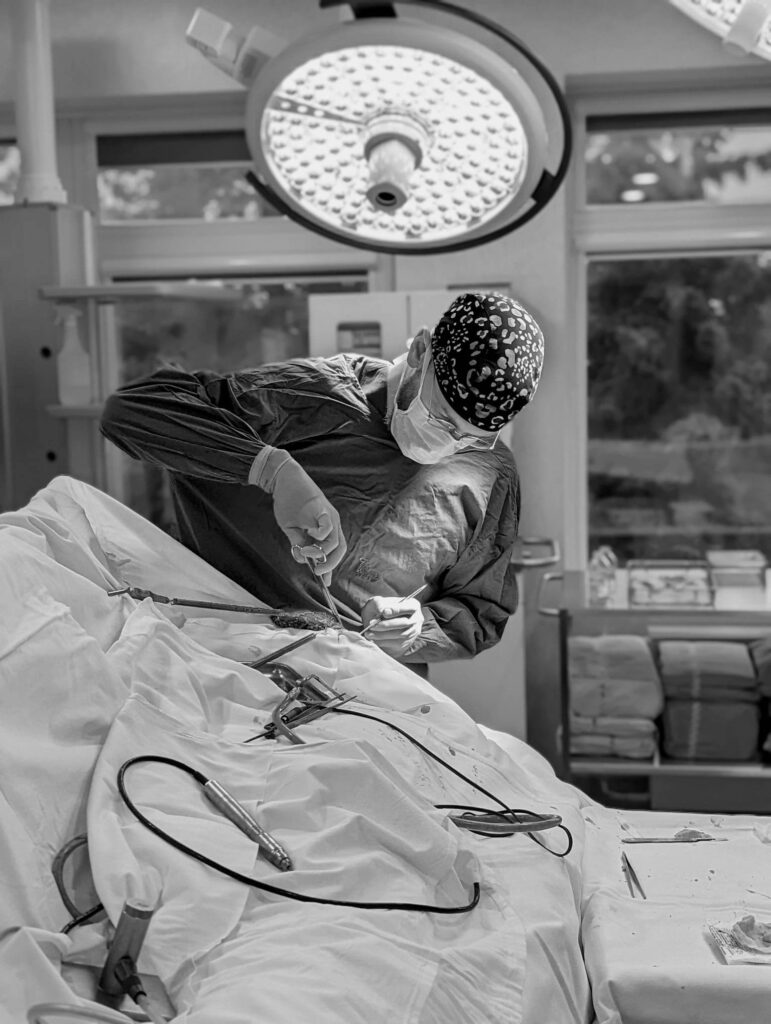
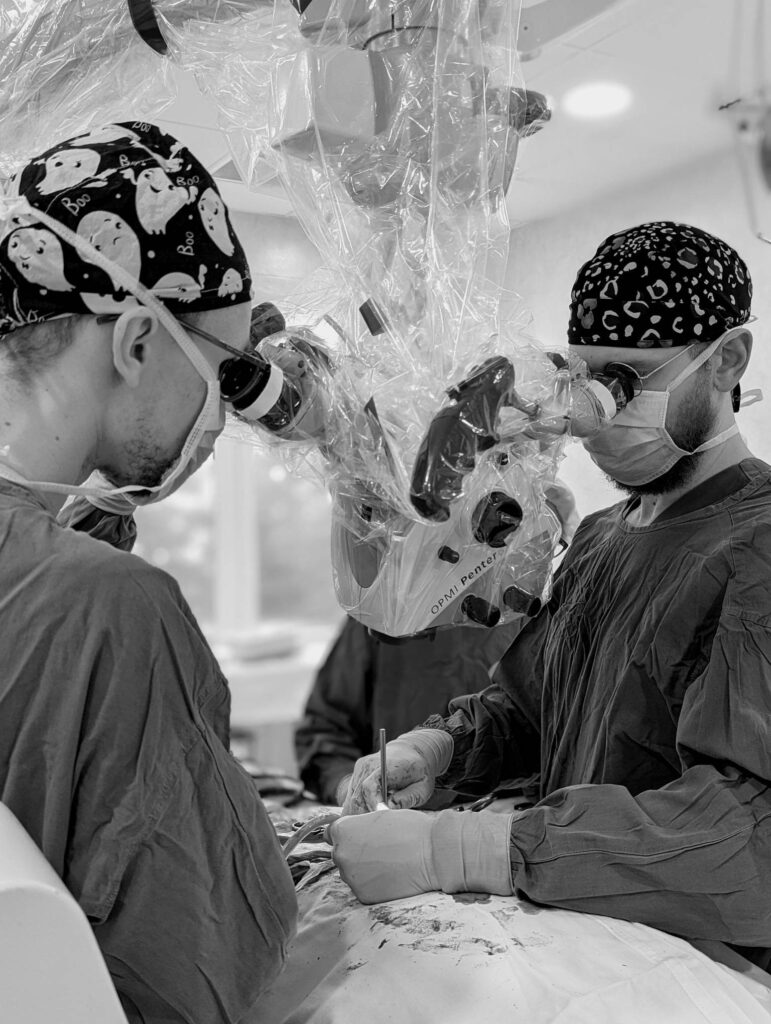
Active curiosity, work in the hospital, involvement in student research activities, and hands-on experience in the operating theatre all helped him discover and closely observe the field of neurosurgery. Later, an opportunity arose almost by chance – a vacant niche in student research within this field, along with frequent opportunities to assist in surgery. As he became more involved in neurosurgery, it gradually grew on him.
Being a doctor: a personal dimension and self-expression
According to the neurosurgeon, the most important quality in a doctor is resilience: this is a profession where people come with their misfortunes. It is equally important to maintain professional distance, as well as physical endurance (a surgery can last many hours), strong concentration, and the ability to work in a team.
An unexpected advantage for a doctor can be a musical background. Piano training helped develop fine motor skills and sensitivity, enabling the hands to adapt to different types of tissue – from extremely delicate to firm – which is highly valuable in surgery.
He emphasises that real-life medicine differs from its idealised image: once you begin to understand diseases and their treatment, you also become aware of your own limitations. That is why what matters most is not grand slogans or overambitious claims (such as “I will cure cancer”), but consistent work and learning, along with an inner commitment to seek new solutions and keep moving forward.
With such responsibility, focus, and pressure, how does a doctor cope with stress and unwind after a demanding day?
Graduates of Lithuanian University of Health Sciences particularly emphasise the value of active, high-quality physical exercise.
For K. Bareikis, stress relief includes running and obstacle racing. One method he chooses is rather extreme – cold water immersion: “You plunge into an ice hole, and you calm down very quickly. The physical challenge leaves no time to think about problems.”
His passion for music has not disappeared either – he still sings in a choir with colleagues.
K. Bareikis’ insights for those considering a career in medicine
- Don’t commit too early to a specific speciality. It is better to choose a broader field first, rather than a narrow specialisation.
- Medical studies offer a wide range of opportunities – both in clinical practice and beyond. However, studies alone are not enough: you need to immerse yourself in the full academic life at Lithuanian University of Health Sciences, as that is where real growth happens.
- Student activities, the LSMU community, and practical experience help shape you not only as a professional but also as a person. At university, you learn to take responsibility not just for yourself, but for others as well.
- Studying medicine at LSMU is worthwhile because it opens broad opportunities for both professional and personal development. There is hardly another field as engaging, where you can become not only a medical professional but also a reliable collaborator, a health advocate, a researcher, a communicator, or an expert in areas such as health policy, health law, health economics, bioethics, and many others.
More about the medical studies at LSMU HERE.
BackRecent articles